The July 2024 student uprising began as a protest over the reinstatement of the public service quota system and grew, within weeks, into one of the most consequential political moments in Bangladesh’s recent history. A new study by Md. Rakibul Islam and Md. Noman Amin of the Department of Sociology, Gopalganj Science and Technology University, asks a simple but important question: what actually made the movement work?
Why This Study Matters
Much of what we know about social movements comes from Western and East Asian settings, where civil liberties and institutions differ sharply from South Asia. Classical resource mobilization theory expects money, organisation and material support to drive success. The July uprising offered a rare chance to test that expectation in a politically constrained, digitally connected environment.
How The Study Was Done
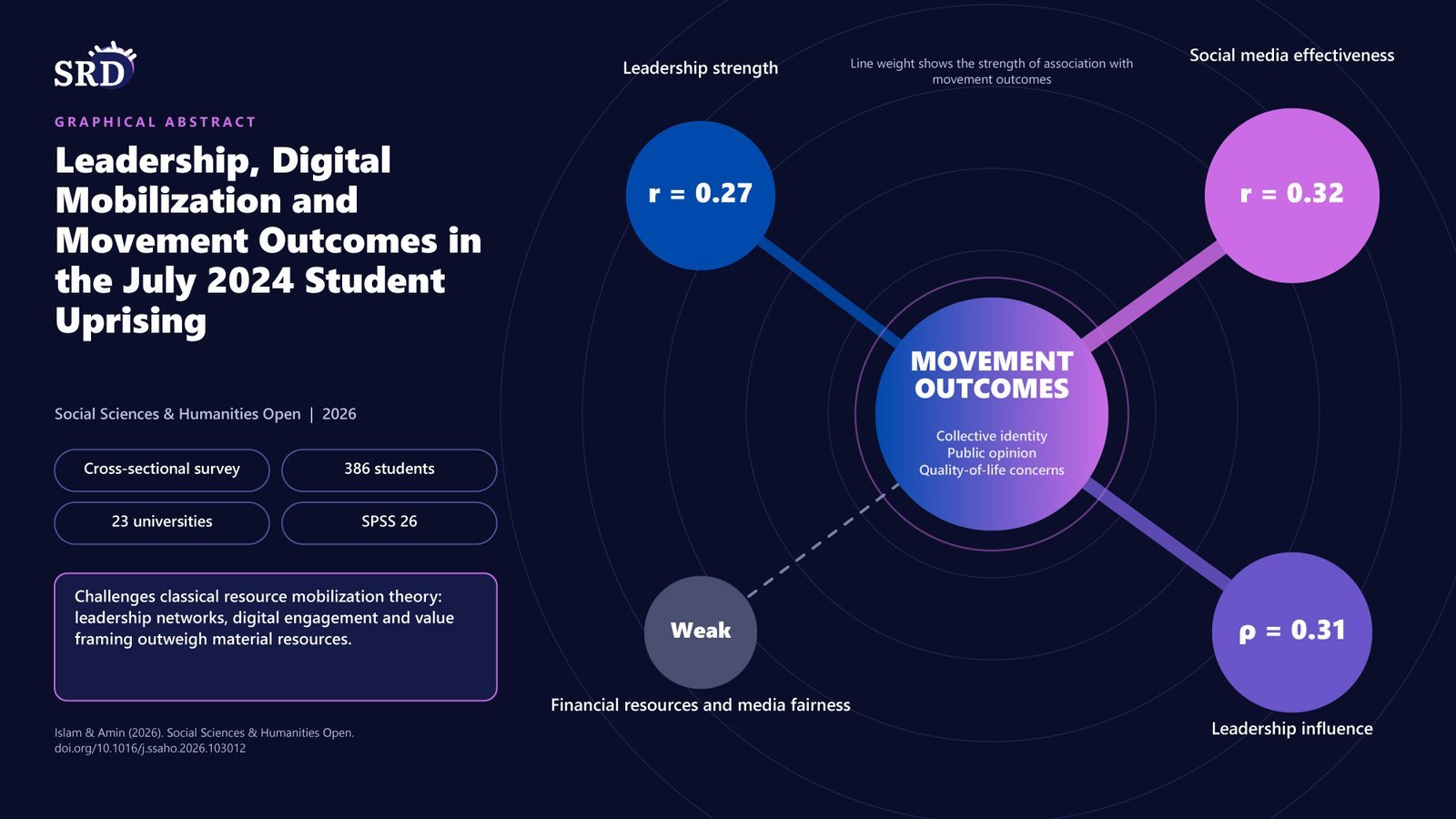
The authors used a quantitative cross-sectional design, surveying 386 university students from 23 universities who were connected to the movement. They measured leadership strength and influence, social media effectiveness, financial resources and media fairness, and examined how each related to movement outcomes such as collective identity, public opinion and quality-of-life concerns. Analysis was carried out in SPSS 26, and the study received ethical approval from SRD’s Ethical Review Board.
Key Findings
- Leadership mattered most. Leadership strength (r = 0.274) and leadership influence (ρ = 0.307) were among the strongest correlates of movement outcomes.
- Social media was the engine. Social media effectiveness showed the strongest association (r = 0.320), acting not only as a channel for information but as an emotional and cultural space that built solidarity.
- Money mattered little. Financial resources and perceived media fairness showed weak or non-significant links with outcomes.
What It Means
The findings challenge a core assumption of resource mobilization theory. In digitally mediated, youth-led movements, leadership networks, online engagement and value-based framing can outweigh material resources. Voluntary labour, symbolic capital and shared identity did the work that money is usually expected to do. The study opens new questions about the long-term political effects of such movements in postcolonial societies.